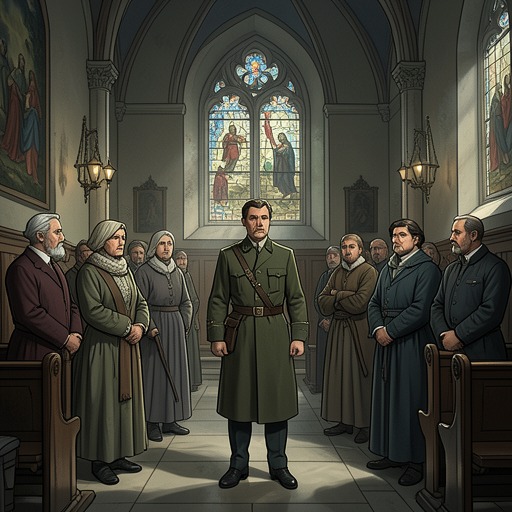
The authorities’ suppression of Danjel’s Åkian meetings and Communion
The EmigrantsThe authorities’ suppression of Danjel Andreasson’s Åkian meetings and Communion is a campaign by church and civil officials to stop the gatherings at Kärragärde, where Danjel preaches and administers the Lord’s Supper. It moves from public warnings and formal prohibitions to a nighttime raid and court sentences. The result is not merely the punishment of one household: the congregation is scattered, most participants return to the established church, and only Ulrika of Västergöhl and her daughter remain with Danjel.
Background and the Church’s Authority
The conflict grows out of competing claims to religious authority. The people of the parish had been raised within the evangelical-Lutheran religion under the church law of 1686, while the royal Resolution and Order of January 12, 1726, was intended to preserve Christian unity in teaching and protect the parish from ideas officials regarded as dangerous. In this setting, a private meeting for Bible teaching was not treated simply as an expression of personal belief: preaching without ordination and gathering for worship outside official supervision challenged the church’s authority over religious practice.
The activity at Kärragärde first came to the attention of Dean Brusander as reports that people were meeting under the pretext of devotion and that Danjel was preaching the Åkian faith. Brusander summoned Danjel to the parsonage and questioned him in the presence of Pastor Krusell and the parish churchwardens. He declared that Danjel was not permitted to minister without a call and ordination under church law, and ordered him to give up his preaching. When Danjel persisted, the dean warned that continued activity could bring a civil suit, a fine or imprisonment on bread and water, and, after a third offense, two years of exile.
Brusander also carried the warning beyond the parsonage. For three Sundays in succession he read from the pulpit the ordinance against private religious meetings, which threatened people of any age or sex with fines, prison, or exile for gathering in houses under a religious pretext. He specifically warned parishioners against Kärragärde, marking the farm as a prohibited meeting place. Yet the repeated notices did not end the gatherings. The dean subsequently excluded Danjel and his household from Holy Communion and from the church’s sacraments and fellowship. The ban made the dispute immediate within the household: Danjel’s wife felt troubled when she disobeyed him, while the biblical teaching about a wife’s submission to her husband pressed upon her conscience.
The Night Gathering and Raid
The decisive confrontation came after Per Persson, a churchwarden, reported that Danjel was holding nighttime meetings behind locked doors and administering the Lord’s Supper. To Brusander, this was a more serious transgression than unauthorized Bible explanations. He regarded the sacraments as the church’s exclusive prerogative and accused Danjel of setting up a congregation and conducting his own church in his home.
The gathering was arranged for an hour before midnight. Two married couples from neighboring farms arrived through the snow and were welcomed into the house, where Danjel’s family, servants, and lodgers had assembled. Danjel locked the door, a measure he reserved for the occasion when he believed the Lord Himself was calling. He invited the visitors to take their places at the table and sat at its head with his one-string psalmodikon. The assembled believers understood the Communion as part of their redemption: through faith in Christ’s suffering and death, they believed themselves cleansed of sin and reborn. The religious meaning of the rite to the participants stood in direct contrast with the authorities’ definition of it as an unlawful usurpation.
When the knock came, Danjel asked who was disturbing the stillness of the house. Sheriff Lönnegren entered with Brusander, Pastor Krusell, Per Persson, the village bailiff, and the sheriff’s hired man. Three represented spiritual authority and three temporal authority; the clergy wore their official black garments. Brusander pointed to the table and declared that they had caught Danjel administering the sacrament. The sheriff said that he would question Danjel and that both he and the others present would be brought into civil court. The inspection turned the intimate household observance into a witnessed offense, joining church accusation to state enforcement.
Trial, Sentences, and Dispersal
At the Konga County spring court in 1849, Danjel was fined two hundred daler in silver for violating the sacrament law and the ordinance against unlawful meetings. Those who had received Communion in his home were each fined one hundred daler in silver. Most could not pay; their fines were therefore converted into prison sentences, and each served twenty-eight days on bread and water. The penalties extended the consequences of the raid from the leader to the people who had gathered around his table.
After serving their sentences, six of those condemned—including former soldier Pihl, maid Sissa Svensdotter, and four neighbors—returned to the established church. They expressed repentance to Brusander, confessed the church’s religion as the only true and right one, and were readmitted to Communion. The remaining community contracted sharply: Ulrika of Västergöhl and her daughter continued to follow Danjel’s teachings, while the court’s sentence had scattered the rest of the small flock. No new followers came to him, and officials considered the danger of Åkianism in the parish averted through cooperation between religious and secular authorities.
Significance in the Narrative
The suppression proceeds by making religious dissent legible to institutions in stages: reports identify the meetings, the dean defines the teaching as unlawful, public readings warn the parish, the church ban excludes Danjel’s household from the sacraments, and the raid supplies witnesses for prosecution. The authorities’ differing roles converge at the table in Kärragärde, where a practice the participants understand as communion with Christ becomes, in official eyes, evidence of a punishable offense.
The episode also distinguishes formal religious order from lived belief without reducing the conflict to a disagreement over doctrine alone. Danjel’s household holds Bible talks, prayers, and Communion as parts of a shared religious life; officials insist that preaching and sacramental rites belong under ordained church authority. The final dispersal shows the force of the law and the church ban, but it does not erase the dissenting belief: Ulrika and her daughter remain with Danjel after the others return to the congregation.
The confrontation belongs to a larger pattern in which conviction and institutional power meet under pressure. Later, amid the storm at sea, Danjel turns to the Bible and reads the ninety-third Psalm, whose words declare that the Lord is mightier than the waves. The remembered scriptural assurance places his faith beside another scene of authority and danger, while the Kärragärde proceedings establish the cost that his religious independence had already exacted on land.